MidiMuse_v2
MidiMuse
A MIDI companion for OP-XY · iPhone and Mac

Play an idea. Take it further.

Capture a loop. Explore four reorderable MIDI tools. Keep the takes you like, then send them back to your OP-XY.

Hands-on MIDI tools. Runs on your device. No AI key required.
iOS 26 · macOS 26USB or Bluetooth MIDI
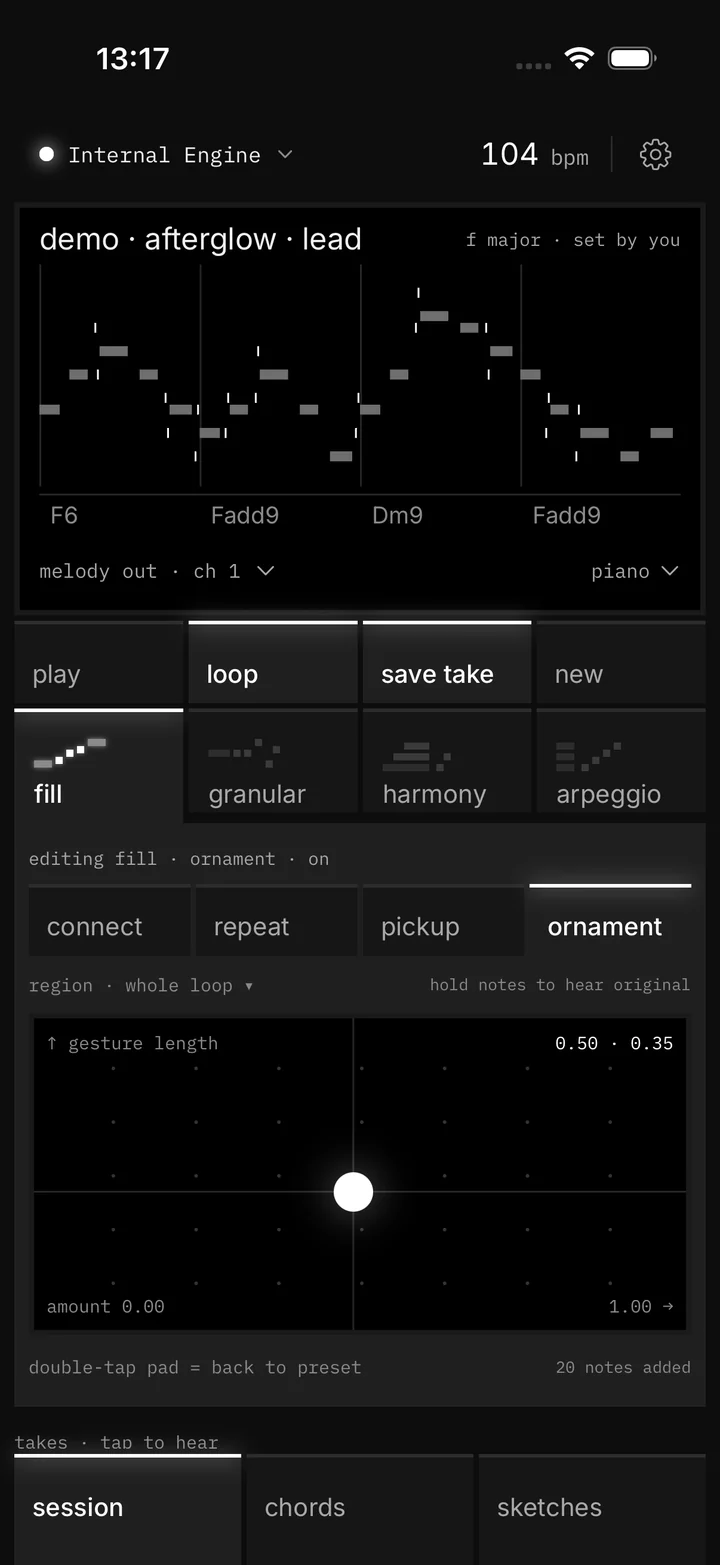
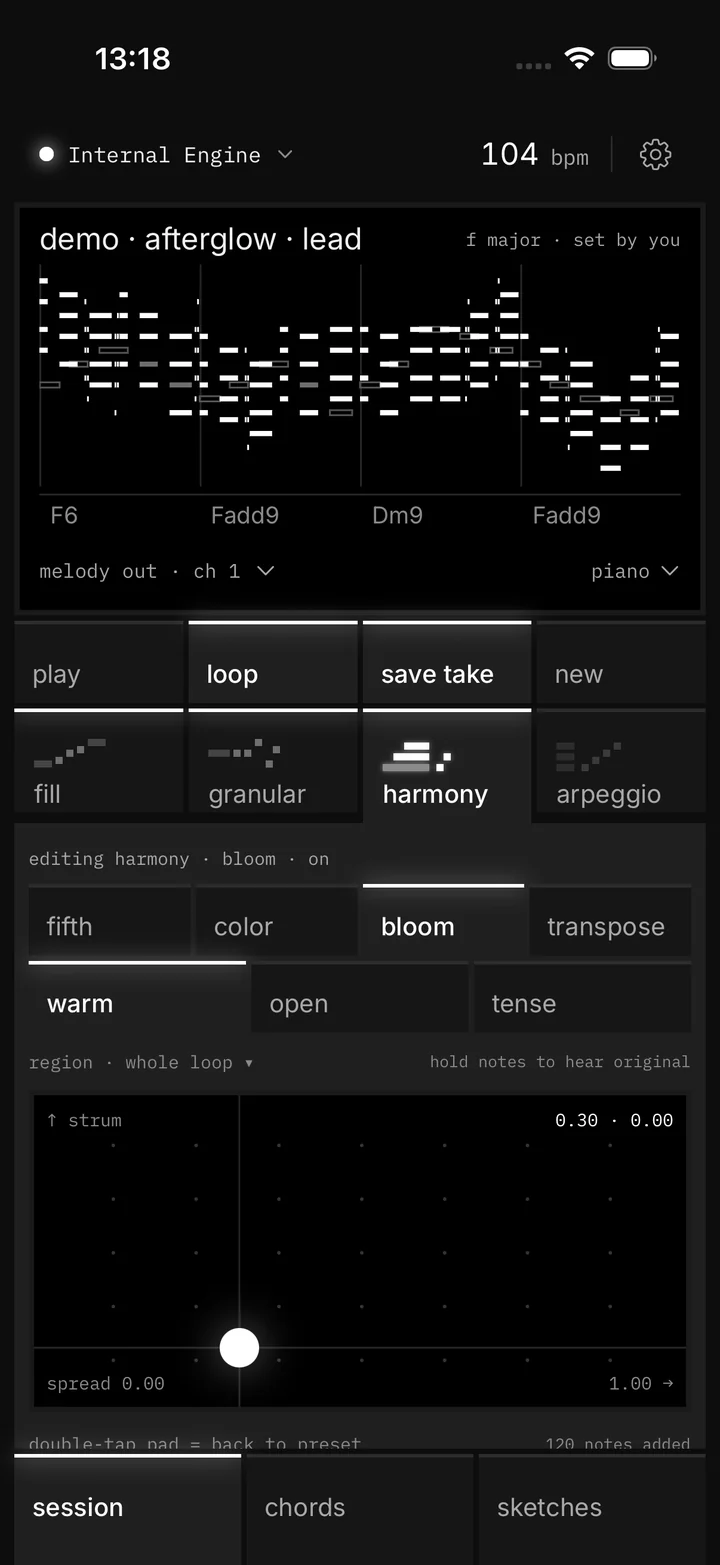
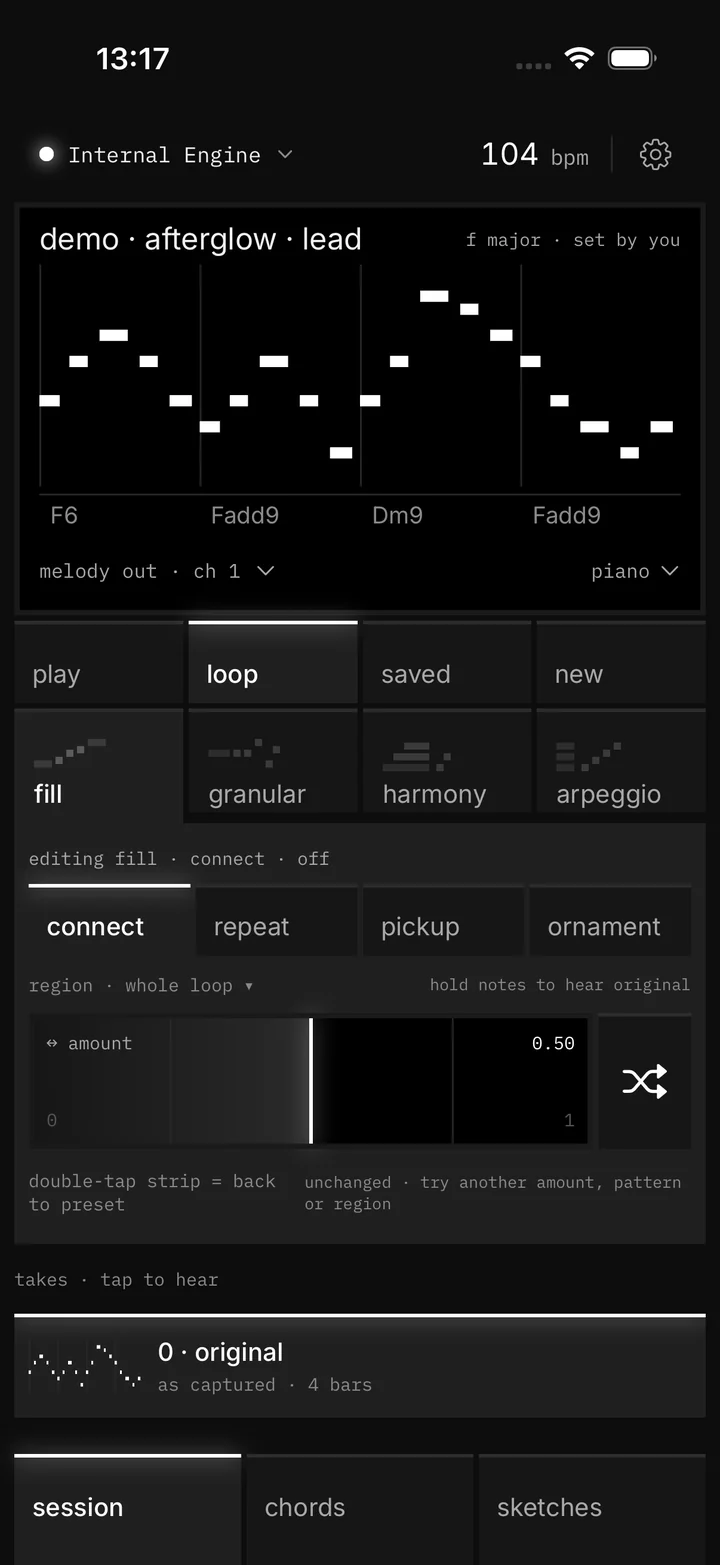
MidiMuse Session screen: a captured lead in the black note display, chord lane F6, Fadd9, Dm9, Fadd9, the play, loop, saved and rec buttons, and the four tool families fill, granular, harmony and arpeggio.
how it works

Capture. Reshape. Send.

Your idea stays on the black note display the whole time, so you hear and see every change together.

01 · capture

Start with something you played.

Connect over USB or Bluetooth, choose 1, 2, 4 or 8 bars or free, and play. Capture starts on your first note, and chords come through too.

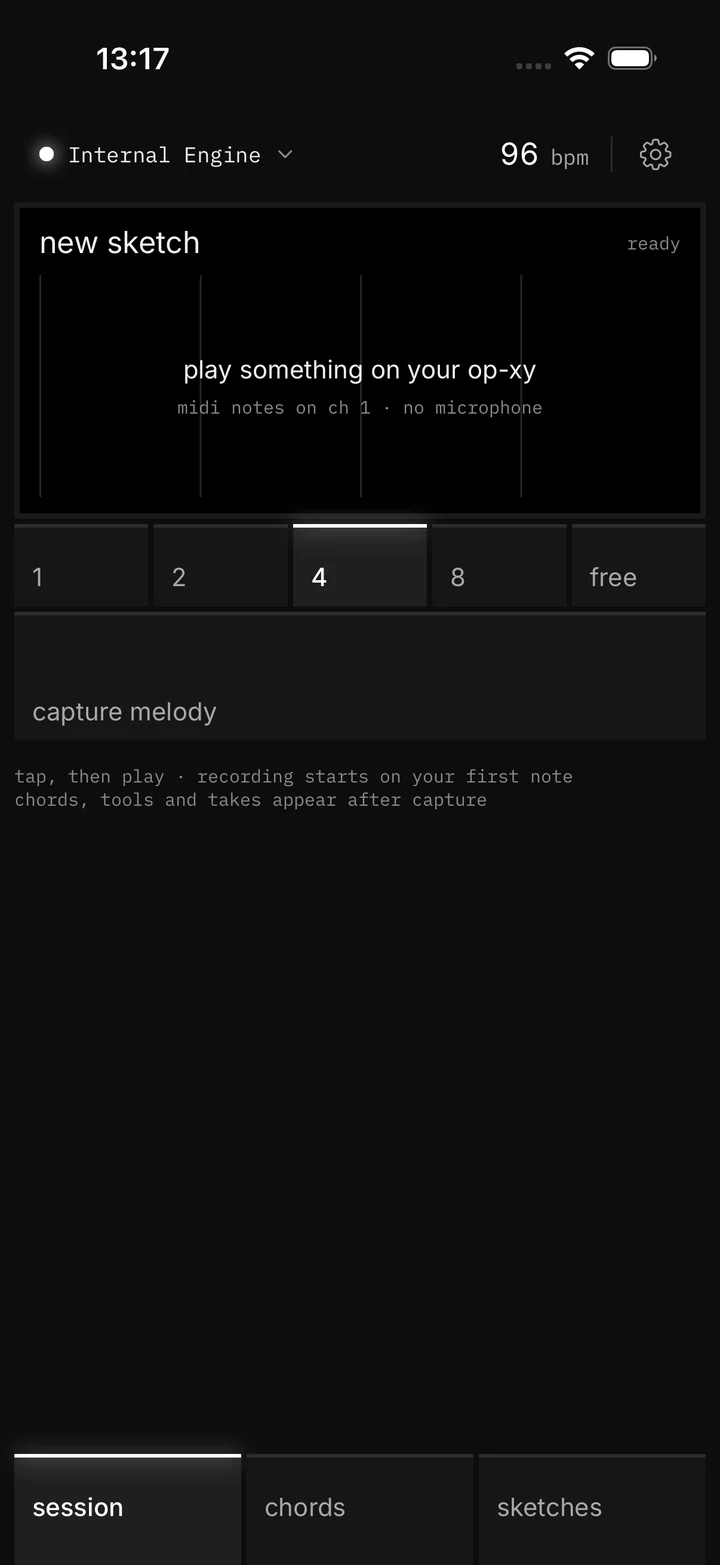
Empty session ready to capture: play something on your op-xy, capture lengths 1, 2, 4, 8 and free.
02 · reshape

Find another direction without losing the original.

Run the loop through Fill, Granular, Harmony and Arpeggio. Change a setting and the loop keeps playing.

Fill · Ornament editor with an amount and gesture length field below the four Fill modes.
03 · send

Bring the take back into your setup.

Play one pass into your armed OP-XY, or export MIDI for your DAW.

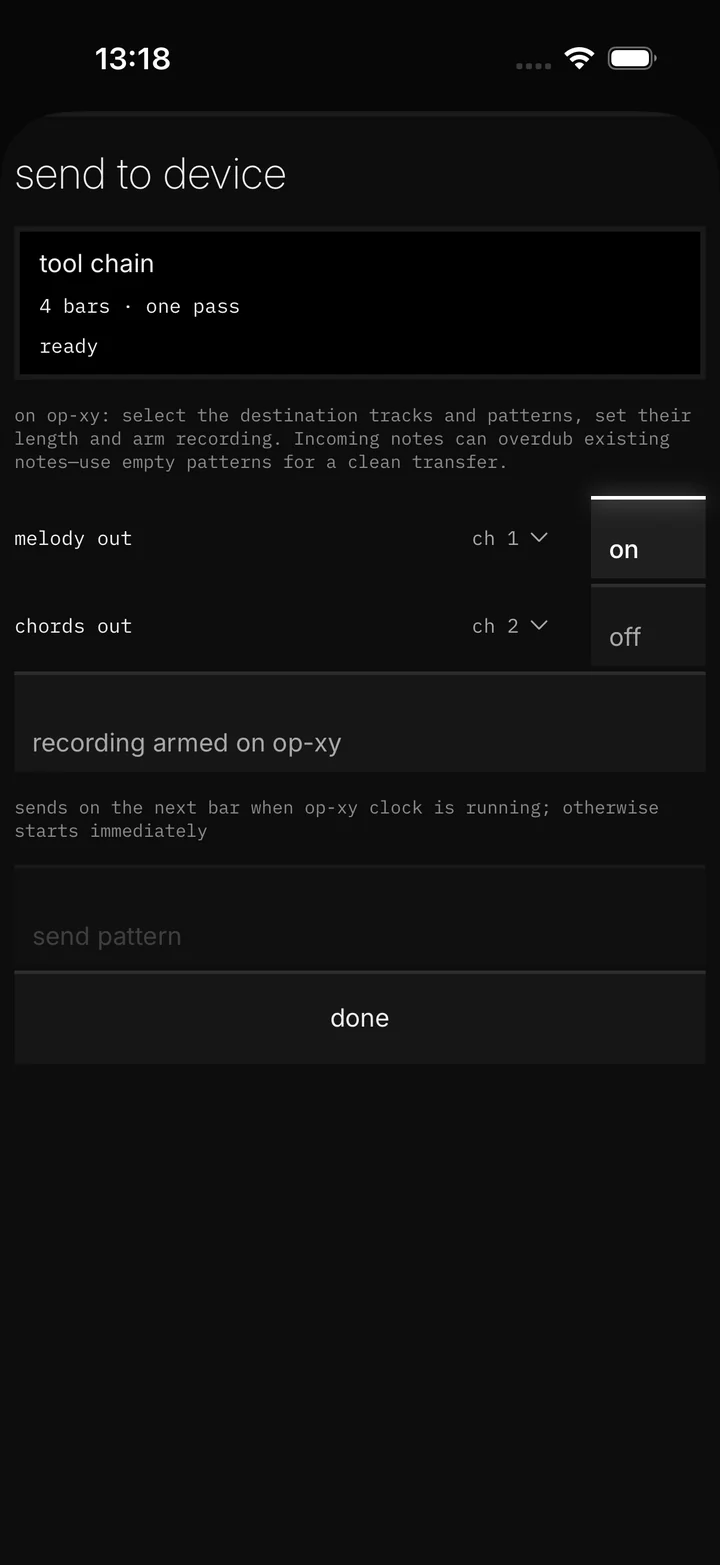
Send to device sheet: melody out on channel 1, chords out on channel 2, recording armed on op-xy, send pattern.
midi tools · four families · try it

Four tools. Your order.

Switch on any combination, drag them into the order you want, and each stage works on the result of the one before. Press play and change things while it loops.

the app · fill · ornament
demostopped
tap a family to edit · tap again to switch it on or off · hold and drag to reorder (keyboard: shift + ← →) · hold the notes to hear the original
The slow orbit demo sketch from the app, played with the app’s Soft Keys and Warm Synth sounds. The modes are simplified browser sketches. Grey outlines are the source, white is the result. The app’s processing and sounds go further.
takes · order matters

Four takes from one sketch. Load one, then keep changing it.

lit strip

A glowing top line means the stage is on, whether you’re editing it or not.

tap · tap again

Tap a family to open its editor. Tap it again to switch it on or off.

hold and drag

Reorder the families. A white line shows where it will land.

keeps playing

Changes land while the loop runs, at the same position.

chords

Play chords over it.

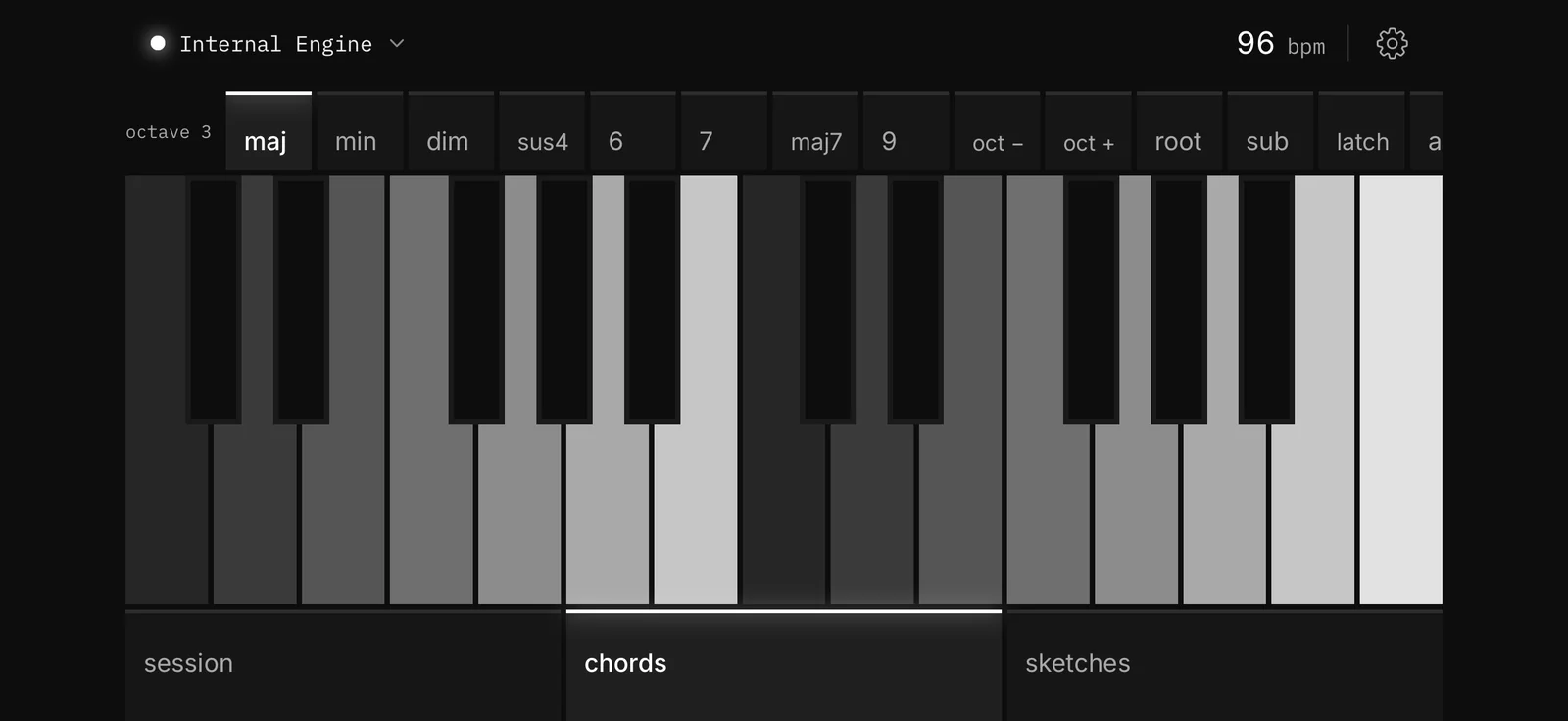
Turn the phone sideways and the chord keyboard spans two octaves. Every key plays the chord shape you picked.

Landscape chord keyboard: two octaves of grey keys, with maj, min, dim, sus4, 6, 7, maj7, 9, oct −, oct +, root, sub and latch controls above.
the app · landscape · two-octave keyboard, chord controls on top
try it · suggested chordshold a pad · glide between them
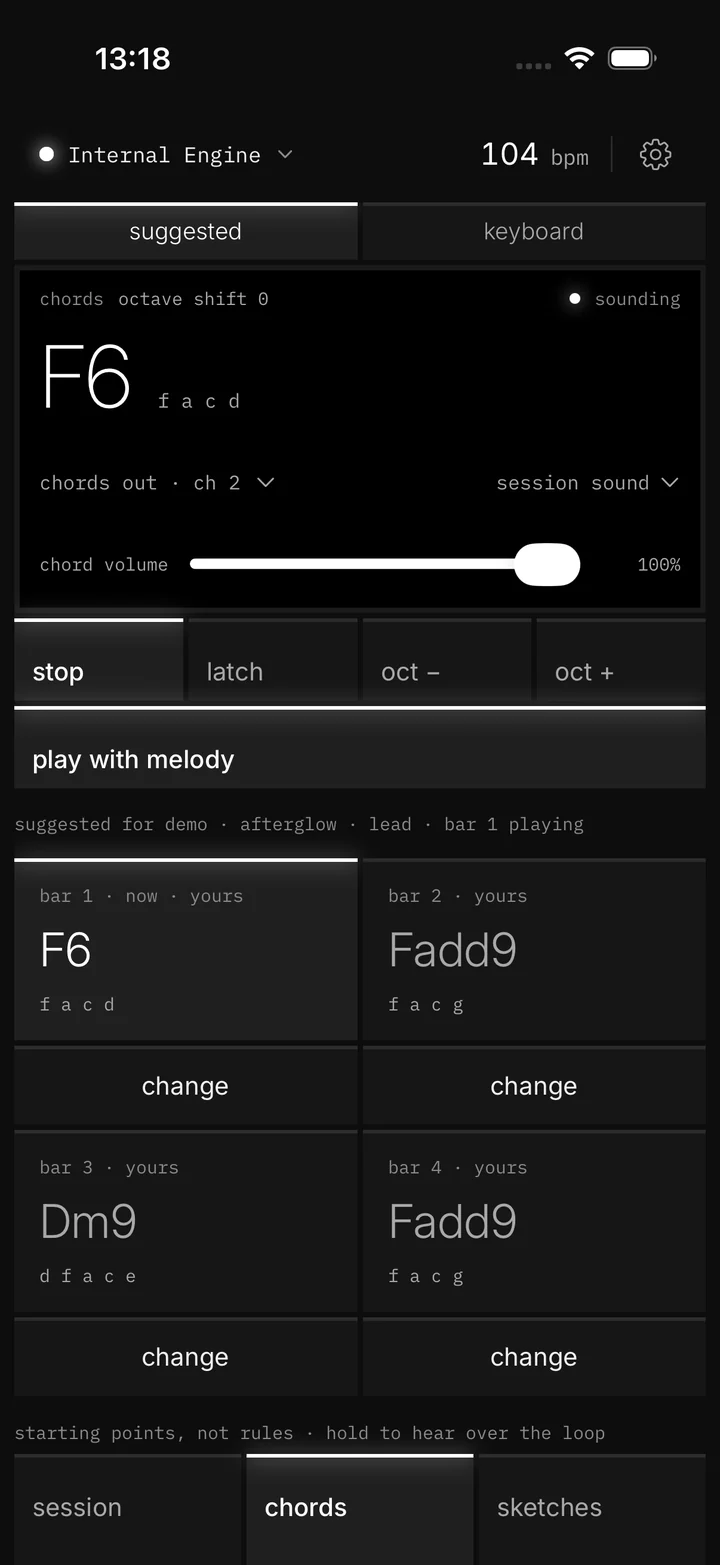
chords · octave shift 0silent
F6f a c d
play with melody runs the demo loop from the tools section with these chords on top
Suggested chords during playback: F6 sounding, play with melody on, bar pads F6, Fadd9, Dm9, Fadd9.
the app · suggested chords follow the loop
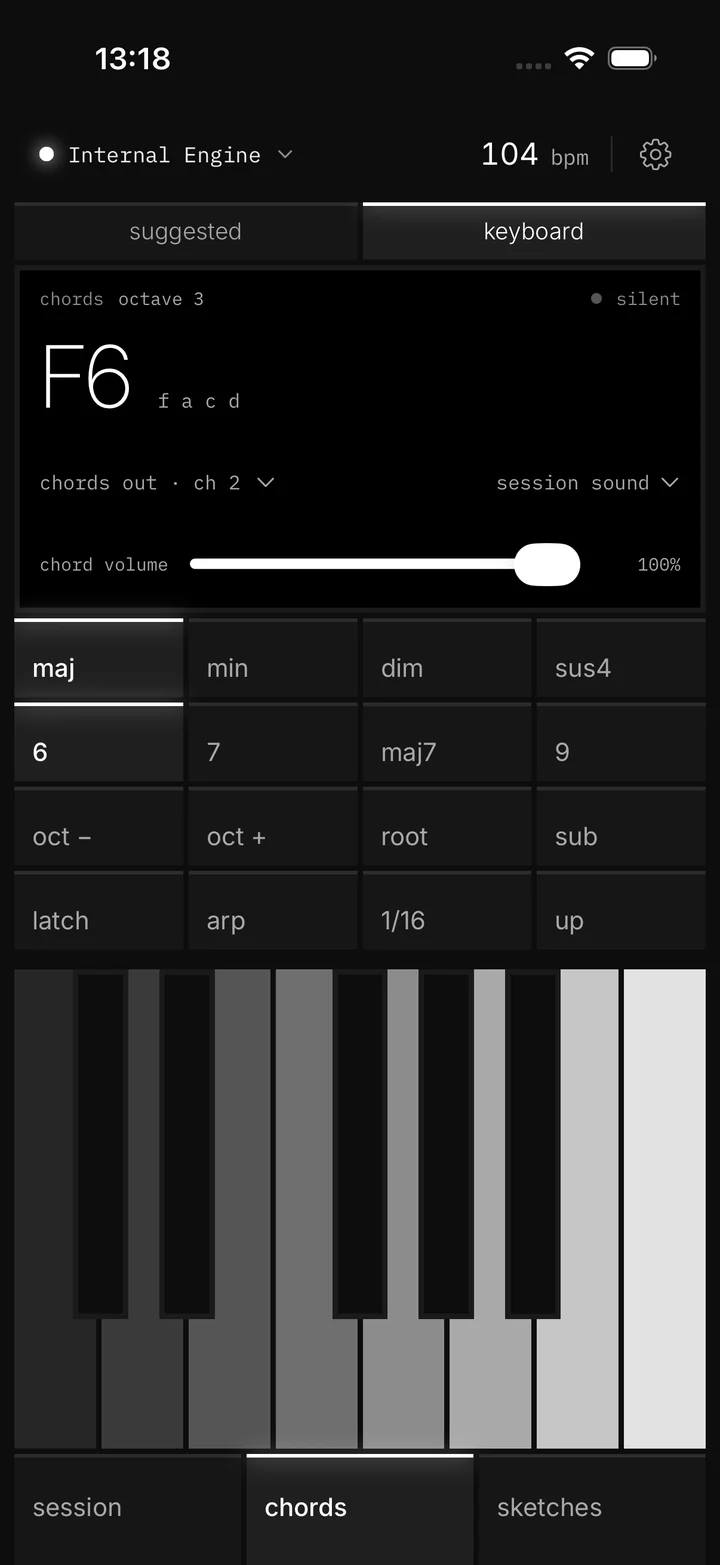
Portrait chord keyboard with chord qualities, extensions, octave, inversion, sub, latch and arp controls.
the app · portrait keyboard with arp
  • suggestedA chord for each bar, based on your notes. Hold and glide between pads; quick taps retrigger.
  • play with melodyThe chords play along with the loop on their own channel.
  • keyboardMaj, min, dim, sus4, sixths, sevenths, ninths, inversions and a sub octave. Glide across keys.
  • latch · arpHold a chord, then turn it into a pattern: up, down, up–down, center–out or random, with gate, swing and accents.
  • own soundPick a separate chord sound and balance it with its own volume.
harmony · bloom

Changes the take

Builds chord voicings into the take’s notes.

suggested chords

Plays alongside

An accompaniment layer during playback. It stays separate from the take.

keyboard

You play it

A chord instrument for trying ideas or picking a bar’s chord yourself.

internal engine

Keep working away from the hardware.

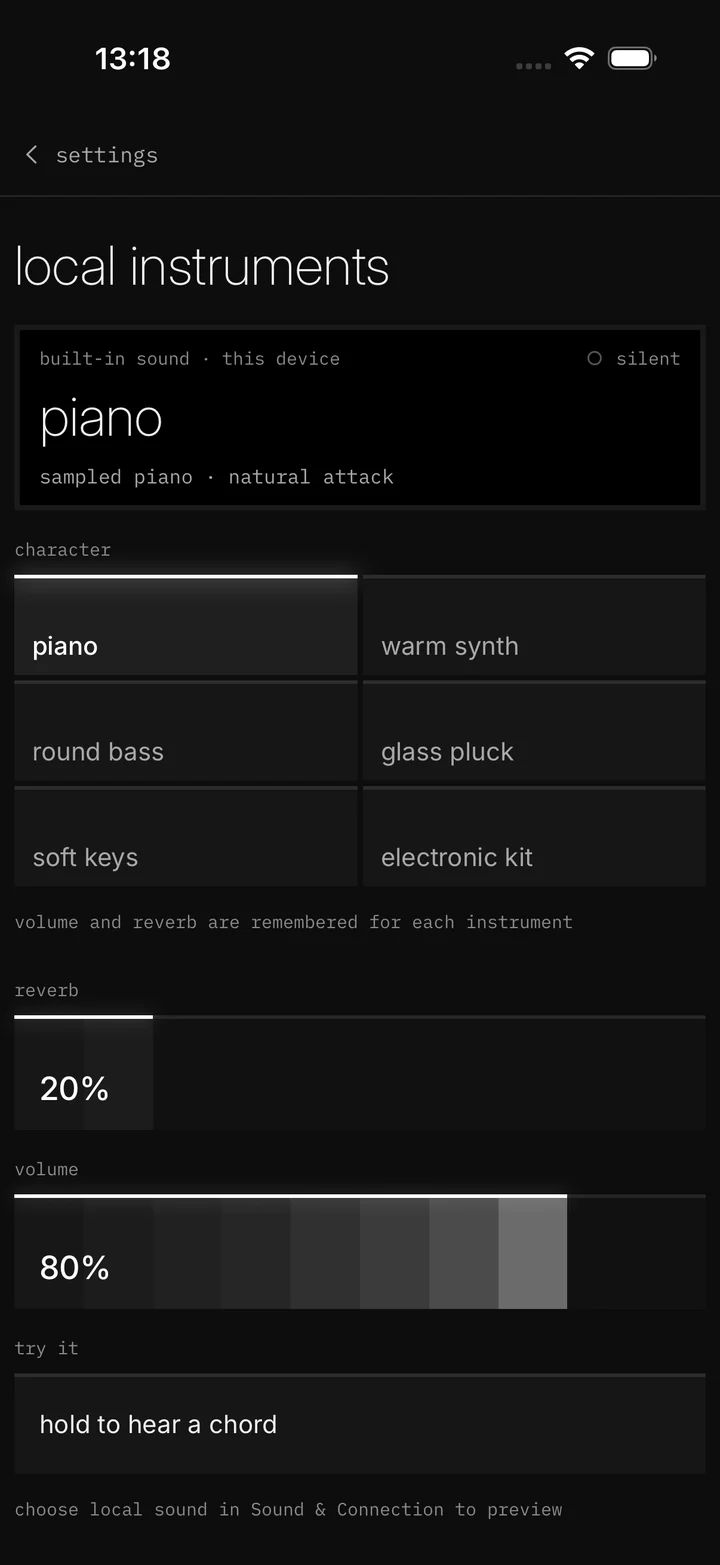
Six built-in sounds play your saved sketches and takes offline, so you can keep reshaping on the train. Capturing new ideas needs a MIDI source.

piano
warm synth
round bass
glass pluck
soft keys
electronic kit
80%volume
20%reverb

Each sound remembers its own volume and reverb, 0–100%. Choose Internal Engine and the sounds play even with your OP-XY still connected.

Local instruments settings: piano selected, six sounds, reverb 20% and volume 80% level fields.
settings · local instruments
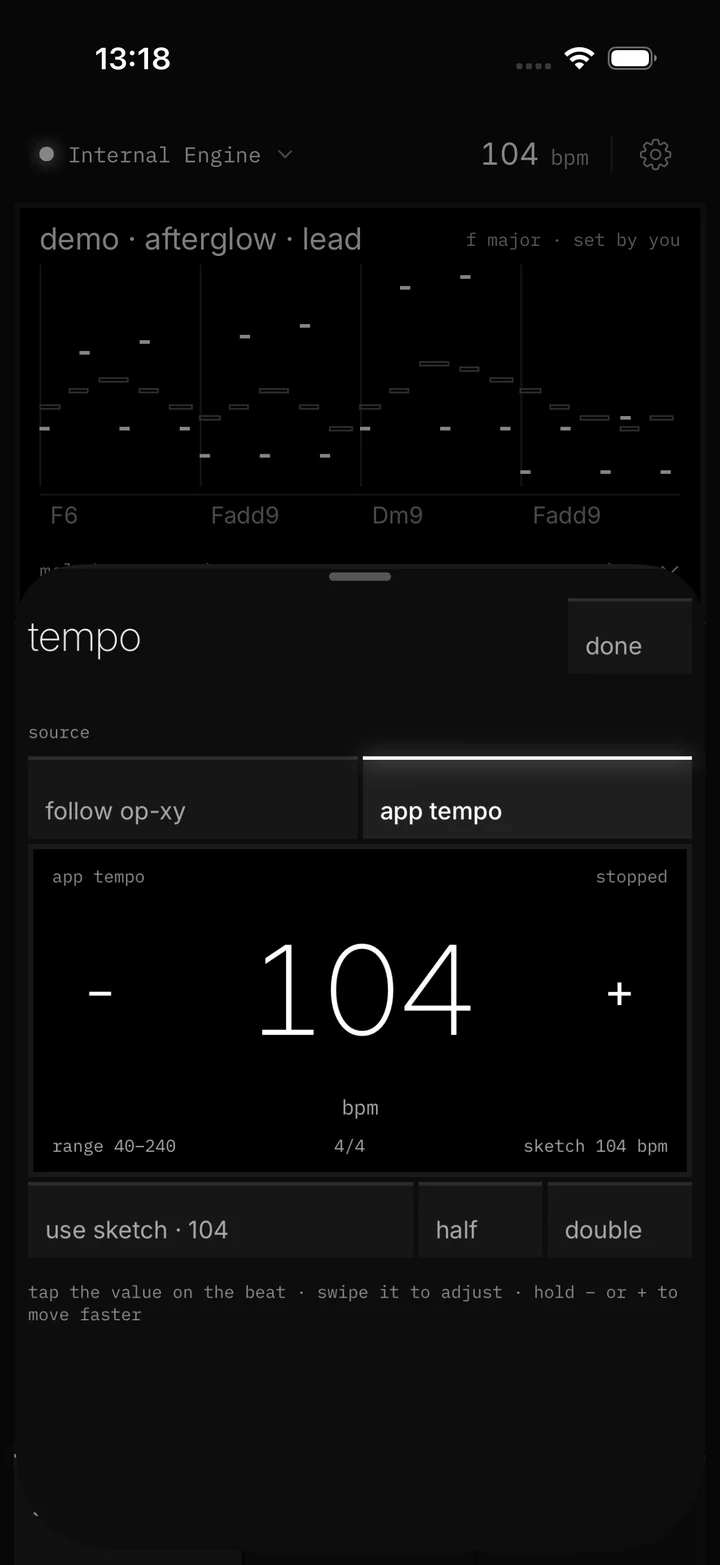
Tempo sheet: follow op-xy or app tempo, 104 bpm field with minus and plus, use sketch, half and double.
tempo · follow op-xy clock or set your own
on the mac

More room on the Mac.

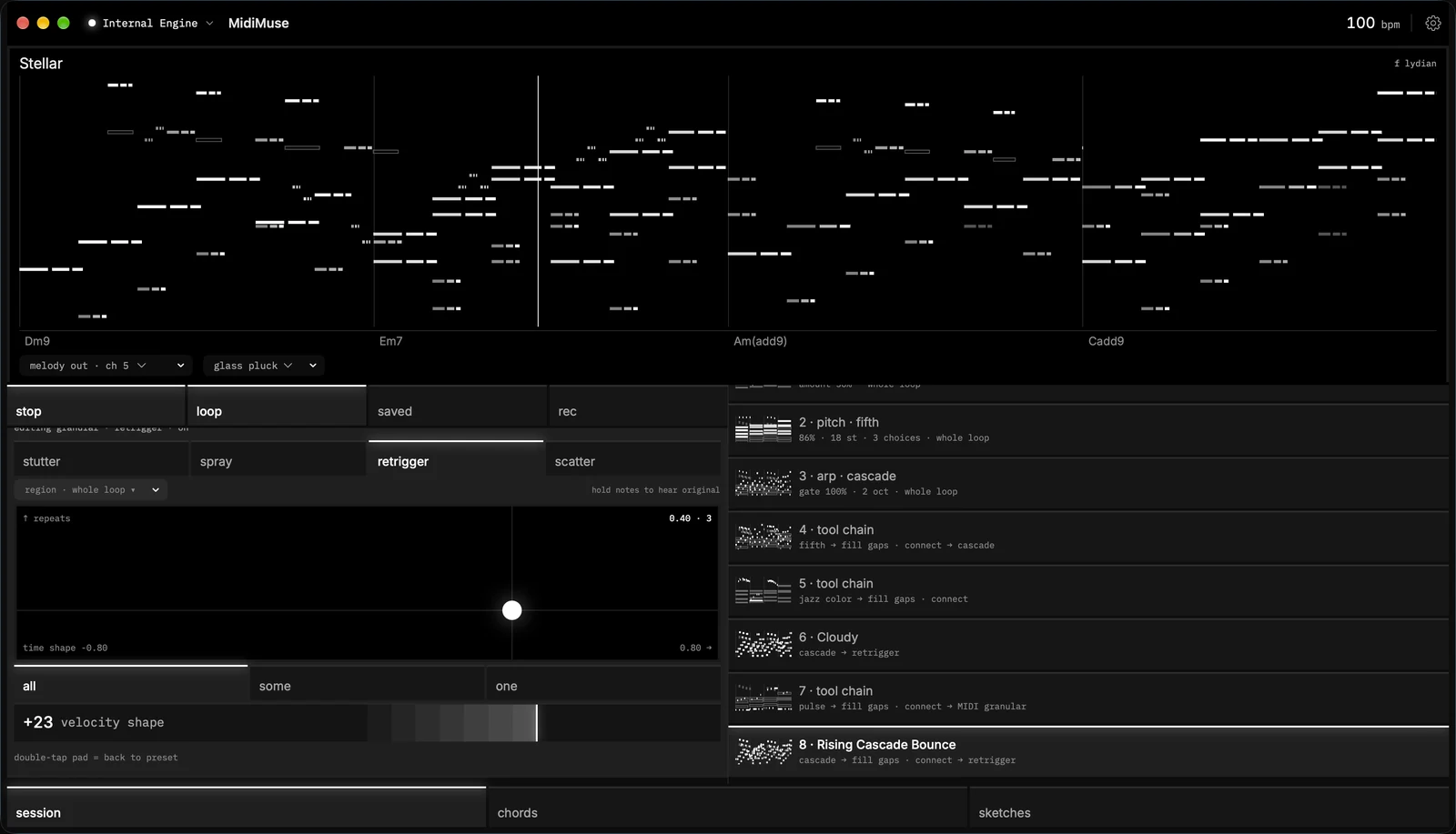
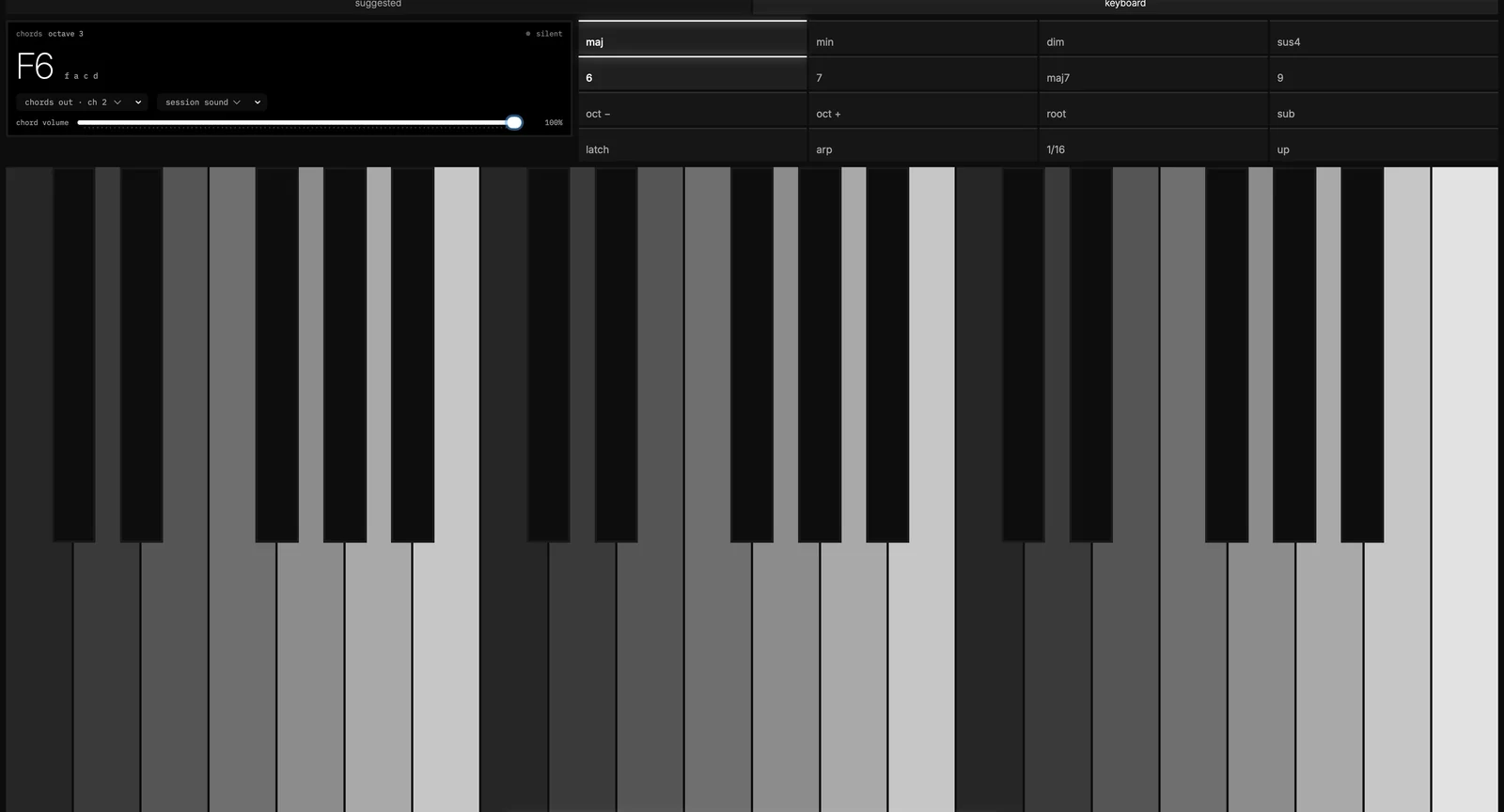
Session shows a taller note display with the tools on the left and your takes on the right. The chord keyboard grows with the window, up to three octaves.

MidiMuse on Mac: the sketch Stellar playing in F lydian, with the note display on top, Granular Retrigger open on the left and eight saved takes on the right.
the app on mac · session, with takes beside the tools
MidiMuse on Mac: chord keyboard spanning three octaves with chord controls above.
the app on mac · three-octave chord keyboard
Send to device: tool chain take, 4 bars, one pass. Melody out channel 1 on, chords out channel 2 off, recording armed on op-xy, send pattern.
send to device · shown with a test connection
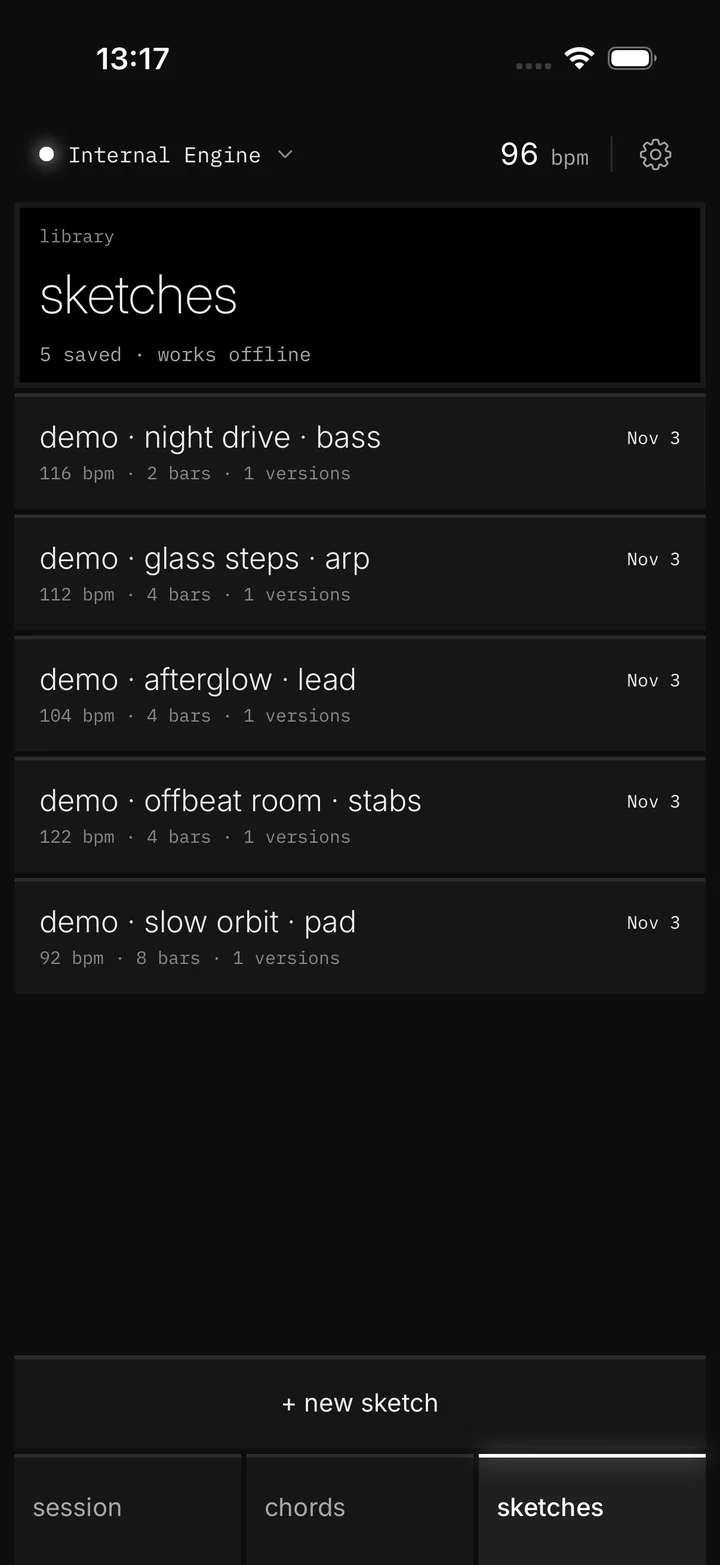
Sketch library with five demo sketches: night drive bass, glass steps arp, afterglow lead, offbeat room stabs, slow orbit pad, plus import midi and new sketch.
sketches · export midi from the library
back into your setup

One pass into your OP-XY, or a MIDI file for your DAW.

  1. On the OP-XY, pick the track and pattern, set the length and arm recording.
  2. Swipe a take and choose send to device.
  3. Switch on melody out and/or chords out and set their channels.
  4. Tap send pattern. MidiMuse plays the take once into the recorder. If the OP-XY clock is running it starts on the next bar, otherwise right away.

Incoming notes overdub what’s already there, so use an empty pattern for a clean copy. MidiMuse doesn’t arm the OP-XY or write pattern files.

Export MIDI saves a sketch as a .mid file with the original, your takes and the chords on separate tracks.

requirements · faq

What you need, and what to expect.

iphone

iOS 26

mac

macOS 26

midi

OP-XY or another MIDI source over USB or Bluetooth

Do I need an OP-XY for everything?

No. Other MIDI sources can be captured too, and saved sketches play on the built-in sounds without any hardware. MidiMuse is designed around the OP-XY.

Does it process audio?

No. It works with MIDI notes only. Granular breaks up notes, not samples, and nothing is recorded from a microphone.

Does it need AI or the cloud?

No. The tools run on your device. No AI key, account or internet connection required.

Can I move between iPhone and Mac?

Yes, if you want to. Optional iCloud sync keeps your sketches and takes in step between your devices, in your own iCloud. Leave it off and everything stays on the device.

Will it overwrite my original?

No. 0 · original is always kept, and every take is saved separately with its recipe.

Can it install pattern files on the OP-XY?

No. Send to device plays one pass into a recorder you arm on the OP-XY. It can overdub, so start from an empty pattern for a clean copy.

Can I use my takes in a DAW?

Yes. Export a sketch as a MIDI file and keep going in any MIDI-capable tool. It works the other way too: import a .mid file into Sketches.
MidiMuse app icon

MidiMuse for iPhone and Mac.

Coming soon to the App Store